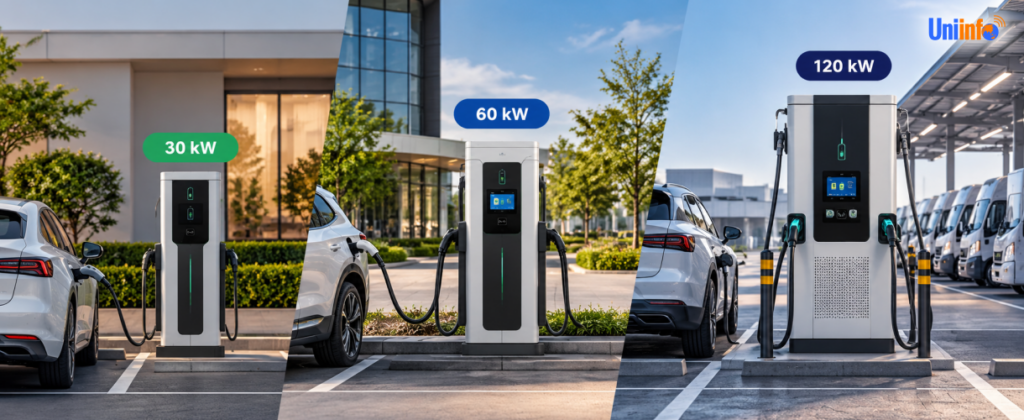
You know your site needs EV charging. The harder question is: how much charging power do you actually need?
One supplier may recommend a 30 kW DC charger. Another may suggest 60 kW. And if you want to “future-proof” the site, a 120 kW charger can sound like the obvious choice.
But bigger is not automatically better.
A 120 kW charger at a low-traffic hotel could mean paying for charging capacity that is rarely used. On the other hand, a 30 kW charger at a busy highway location could result in longer waiting times, lower vehicle throughput, and frustrated customers.
The right choice depends on your vehicle mix, customer dwell time, expected daily charging sessions, available electrical capacity, site type, and business objective.
So instead of asking, “Which charger is fastest?”, a better question is:
Which charging capacity makes operational and financial sense for my site?
30 kW vs 60 kW vs 120 kW EV Chargers at a Glance
| Factor | 30 kW | 60 kW | 120 kW |
| Charging category | DC charging | DC fast charging | Higher-power DC fast charging |
| Typical demand | Low to moderate | Moderate to high | High |
| Dwell time | Longer | Medium | Shorter |
| Electrical requirement | Lower | Moderate | Higher |
| Relative investment | Lower | Medium | Higher |
| Potential applications | Hotels, dealerships, smaller commercial sites | Public stations, malls, restaurants, fleets | Highways, busy charging hubs, high-utilization fleets |
| Main advantage | Lower entry requirement | Balance of speed and capacity | Higher potential throughput |
These are not universal recommendations. The correct charger still depends on the site.
India’s EV charging framework itself covers very different environments, including offices, hospitals, group housing societies, bus depots, commercial complexes, petrol pumps, airports and highways. A charger configuration suitable for one environment therefore does not automatically make sense for another.
External resource: Bureau of Energy Efficiency – EV Charging Infrastructure Guidelines
Before Choosing Charger Capacity, Answer These Five Questions
Before comparing 30 kW, 60 kW and 120 kW equipment, understand what will actually happen at your site.
1. What types of vehicles will charge there?
A charging station serving passenger cars has different requirements from a fleet depot serving commercial vehicles.
More importantly, a charger rated at 120 kW does not guarantee that every connected EV will charge at 120 kW.
The vehicle has its own maximum DC charging acceptance rate. If a vehicle can accept only 60 kW, connecting it to a 120 kW charger does not automatically make it charge at 120 kW.
Battery state of charge, temperature and the vehicle’s charging curve can also affect the actual charging rate.
2. How long do vehicles stay at your location?
This is one of the most important questions.
A hotel guest may leave a vehicle parked for several hours. A highway traveller may want to stop for only 20–40 minutes.
Those two users shouldn’t automatically be served with the same charging strategy.
Longer dwell time can reduce the need for very high charging power. Short dwell time makes charging speed more valuable.
3. How many charging sessions do you expect?
Consider whether the station is likely to serve:
- Fewer than 10 vehicles per day
- 10–25 vehicles
- 25–50 vehicles
- 50+ vehicles
If utilization is expected to be low, investing in significantly more capacity may not immediately produce more revenue.
But undersizing a high-traffic site can create queues and restrict the number of charging sessions you can serve.
4. What electrical capacity is already available?
The charger is only one component of the infrastructure.
Depending on the project, you may also need to consider electrical panels, cables, earthing, sanctioned load, distribution infrastructure and potentially load enhancement.
This is why Uni-Info’s EV charging infrastructure solutions approach the project beyond simply installing charger hardware.
5. What are you trying to achieve?
Are you installing chargers as:
- A customer amenity?
- A new revenue stream?
- A public charging business?
- Fleet infrastructure?
- An employee facility?
- A future-ready property investment?
Your business objective can change the right charger configuration.
When Does a 30 kW EV Charger Make Sense?
A 30 kW DC charger can be worth considering where vehicles have reasonable parking time and very high throughput isn’t the primary requirement.
Potential applications can include:
- Hotels and resorts
- Automobile dealerships
- Restaurants with longer dwell time
- Smaller commercial properties
- Lower-volume public locations
- Certain fleet applications
Its biggest advantage is not simply a lower charger rating.
It can allow a business to provide DC charging without immediately committing to the infrastructure associated with much higher charging capacity.
However, 30 kW may become restrictive if demand grows substantially or customers expect quick turnaround.
If vehicles are regularly waiting for chargers to become available, the lower initial investment may eventually become an operational limitation.
When Does a 60 kW EV Charger Make Sense?
For many commercial projects, 60 kW sits between relatively lower-powered DC charging and high-powered charging.
Potential applications include:
- Public charging stations
- Petrol pumps
- Restaurants
- Shopping centres
- Commercial parking
- Urban charging hubs
- Fleet facilities
A 60 kW charger can make sense when customers need reasonably fast charging but the location does not yet justify significantly higher charging capacity.
However, 60 kW should not become the default answer simply because it sits in the middle.
A site receiving five charging sessions per day has a very different business case from one receiving 40.
Before selecting the charger, the site’s utilization, vehicle compatibility, electrical capacity and future demand should be assessed.
Businesses evaluating such installations can explore Uni-Info’s commercial EV charging solutions to understand how charging can be planned around commercial requirements.
When Does a 120 kW EV Charger Make Sense?
Higher-power charging becomes more attractive when vehicle turnaround has real operational or commercial value.
Examples may include:
- Highway charging stations
- High-traffic public charging hubs
- Taxi and mobility fleets
- Large commercial fleets
- Intercity charging locations
- High-utilization charging facilities
Imagine two charging locations.
Site A receives six vehicles per day.
Site B regularly experiences vehicles waiting for chargers.
Increasing charging capacity at Site B could help improve vehicle throughput, provided the vehicles can use the additional power and the site’s infrastructure can support it.
At Site A, however, a 120 kW charger may spend much of the day unused.
That means the question isn’t:
“Can we install 120 kW?”
It is:
“Will enough vehicles use this capacity to justify installing it?”
Can Every EV Actually Use a 120 kW Charger?
No-and this is an important consideration when planning a charging site.
A vehicle’s maximum DC charging acceptance can be lower than the charger’s maximum output.
For example, if a vehicle can accept up to 60 kW and is connected to a 120 kW charger, the additional charger capacity does not force the vehicle to consume 120 kW.
This principle is also explained in DC fast-charging guidance from vehicle manufacturers: the vehicle’s acceptance rate can limit the actual charging speed even when the station offers more power.
So before investing in higher-capacity equipment, understand the vehicle mix likely to visit your site.
External resource: Chevrolet – Understanding DC Fast Charging Power Levels
Don’t Compare Charger Price Alone
Suppose you receive quotes for 30 kW, 60 kW and 120 kW chargers.
Comparing only the equipment price can give you an incomplete picture.
Your actual project may involve:
Charger hardware + electrical infrastructure + panels + cabling + earthing + civil work + networking/software + installation + testing and commissioning
A higher-capacity charger may also change the site’s electrical requirements.
The Ministry of Power’s current EV charging framework specifically addresses electricity connections and infrastructure requirements for charging stations, including provisions around LT connections up to specified capacities.
That’s why total project requirement matters more than the charger purchase price alone.
Hotel vs Highway vs Fleet: Three Sites, Three Different Decisions
Consider how differently the same decision works in real life.
Scenario 1: Hotel
Guests may park for several hours or overnight.
The hotel may care more about providing convenient charging than maximizing the number of vehicles charged every hour.
Installing the fastest charger available may therefore not automatically produce the best return.
Scenario 2: Highway Location
A highway customer behaves differently.
They usually want to charge and continue their journey.
Here, charging time can directly affect customer experience and the number of vehicles that can use the station.
Higher charging capacity can therefore become more valuable – assuming sufficient demand and compatible vehicles.
Scenario 3: Fleet Depot
A fleet operator may have 50 vehicles returning to the depot in the evening.
The important question isn’t simply:
“Should we buy 120 kW chargers?”
It is:
How much energy must be delivered across the entire fleet before the vehicles need to return to service?
Sometimes, several appropriately sized chargers combined with charging schedules and load management can be more useful than simply selecting the highest charger rating.
This is why fleet charging requires infrastructure planning rather than only charger procurement.
Oversizing vs Undersizing: Both Can Cost You
Oversizing
Imagine installing 120 kW because you want the site to be “future-ready,” but:
- Daily traffic remains low
- Most vehicles cannot use the full output
- Customers stay for long periods anyway
- Electrical infrastructure costs increase
- Charger utilization remains poor
You’ve invested in capacity that isn’t producing enough additional value.
Undersizing
Now imagine choosing 30 kW primarily to reduce initial investment, but demand grows quickly.
You could face:
- Longer charging sessions
- Queues
- Reduced vehicle throughput
- Poor customer experience
- Lost charging opportunities
Right-sizing
The better objective is to match:
Vehicle demand + dwell time + electrical capacity + utilization + business model + future expansion.
Should You Install 120 kW Now to Future-Proof Your Site?
Not necessarily.
Future-proofing doesn’t always mean buying the largest charger on day one.
A better strategy can involve:
- Planning electrical infrastructure for expansion
- Reserving space for additional chargers
- Providing suitable cable routes
- Designing panels for future capacity
- Using load-management systems
- Adding chargers as utilization grows
This allows the project to meet today’s requirements while maintaining a path for tomorrow’s demand.
You can also review Uni-Info’s EV charging projects to see how charging infrastructure can differ across real deployment environments.
So, Which EV Charger Does Your Site Need?
A 30 kW charger can make sense where dwell time is longer, and demand is moderate.
A 60 kW charger can provide a useful balance for many commercial and public charging applications.
A 120 kW charger becomes more compelling when faster vehicle turnaround and higher throughput justify the additional infrastructure.
But charger capacity should never be selected in isolation.
Before making the investment, determine:
- What vehicles will use the station?
- How many vehicles are expected each day?
- How long will they remain parked?
- What electrical capacity is available?
- How quickly must vehicles charge?
- What is the expected utilization?
- How could demand change over the next few years?
Not Sure Whether Your Site Needs 30 kW, 60 kW or 120 kW?
You don’t need to guess.
The right EV charging configuration depends on your site’s location, vehicle traffic, electrical capacity, operating model and future expansion plans.
Uni-Info provides end-to-end EV charging infrastructure for commercial properties, public charging locations, fleets, and other EV charging projects.
Tell us about your site, expected vehicle traffic and charging requirement to evaluate which configuration may make sense for your project.
Find the Right EV Charger for Your Site
Share your project requirements and request a site-specific EV charging assessment.