Your hotel has 150 parking spaces. Your mall has hundreds of vehicles coming in every day. Or your employees are starting to ask when EV charging will be available at the office.
The obvious next question is:
Should you install AC chargers, DC fast chargers, or a combination of both?
It is tempting to assume that DC is automatically better because it charges vehicles faster. But for a commercial property, charging speed is only one part of the decision.
A hotel guest may leave a car parked overnight. An office employee may remain at work for eight hours. A mall visitor may stay for only two hours.
These users don’t necessarily need the same charging experience.
The better question, therefore, isn’t “Is AC or DC better?”
It is: “Which charging setup makes the most operational and financial sense for the way people actually use our property?”
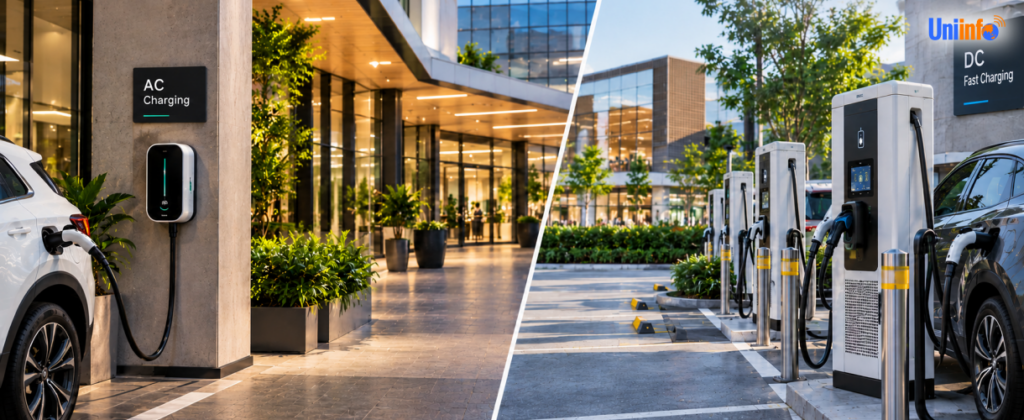
AC vs DC EV Charging: What’s the Practical Difference?
AC and DC charging deliver energy to an EV differently, but property owners don’t need to start with the electrical engineering.
They need to understand how that difference affects their business.
| Factor | AC Charging | DC Charging |
| Charging speed | Generally slower | Faster |
| Hardware investment | Generally lower | Higher |
| Site power requirement | Lower per charger | Higher |
| Best suited for | Longer parking periods | Faster vehicle turnaround |
| Common commercial use | Offices, hotels, destination parking | Public charging, high-traffic commercial sites |
| Number of bays | Easier to distribute across more bays | Often concentrated into fewer high-power bays |
India’s Bureau of Energy Efficiency (BEE) recognizes multiple charging configurations, including Type-2 AC and higher-powered DC fast-charging standards. The appropriate infrastructure depends on the application rather than one charger type being universally superior. For commercial properties, this means AC and DC solve different problems.
Start With Parking Time, Not Charging Speed
One of the biggest mistakes a property can make is choosing chargers based primarily on maximum charging speed.
Instead, ask:
How long does a vehicle normally remain parked here?
Consider three situations.
- A hotel guest checks in at 7 PM and leaves at 8 AM.
- An office employee arrives at 9 AM and leaves around 6 PM.
- A mall customer arrives at 5 PM and leaves at 7 PM.
All three want EV charging, but their available charging windows are very different.
When vehicles remain parked for several hours, AC charging can often use that time effectively. When vehicles need to arrive, charge and leave quickly, DC charging becomes more valuable.
So a useful principle is: Match charging speed to dwell time-not simply to the biggest charger your budget allows.
What Should a Hotel Install: AC or DC Charging?
Hotels have an interesting charging use case because many guests have something other commercial properties don’t: time. If a guest arrives in the evening and the vehicle remains parked overnight, providing the fastest possible charging may not be necessary for every parking bay.
AC charging can therefore make sense for overnight guest parking. But hotels can have other customer profiles too. A resort may have restaurant visitors, conference attendees, event guests, taxis and premium customers who don’t remain overnight. Some of these users may value faster charging.
That means the decision should consider:
- Number of rooms
- Total parking capacity
- Current EV demand
- Average guest stay
- Restaurant and event traffic
- Available electrical load
- Desired guest experience
- Future EV adoption
Instead of choosing exclusively between AC and DC, some properties may benefit from evaluating a mixed charging strategy. For example, multiple AC charging bays could serve overnight guests while strategically placed DC charging could support visitors who need a faster turnaround.
The right combination depends on the property. Businesses evaluating this type of setup can explore Uni-Info’s commercial EV charging solutions for hotels, hospitality properties, workplaces, and other commercial sites.
What Should a Shopping Mall Install?
A mall has a completely different usage pattern. Customers may remain for one, two or several hours, while parking demand can change significantly between weekdays, evenings and weekends.
Here, property managers need to think beyond charger speed.
Ask:
- How many EVs visit daily?
- How long do customers typically stay?
- Will charging be a free customer amenity or a paid service?
- Could chargers remain occupied after vehicles have received enough energy?
- What happens during weekend peak periods?
A mall may decide that several AC charging points provide broader charging access across its parking area. Alternatively, DC fast charging may be valuable for customers who want meaningful charging during shorter visits. For larger properties, the answer may not be AC or DC. It could be AC + DC, with each serving a different visitor profile.
This is why Uni-Info’s broader EV charging infrastructure services include site planning, electrical infrastructure, load management, and scalability rather than treating charger hardware as the entire project.
What Should a Corporate Office Install?
Workplaces present another strong case for looking at dwell time. Employees may leave their vehicles parked for eight or more hours.
That creates an important question:
Does every employee need fast DC charging if the vehicle will remain parked all day?
Often, the bigger workplace challenge isn’t charging one vehicle as quickly as possible. It is figuring out how to provide charging access to many employees without creating unnecessary electrical demand or infrastructure cost.
An office should consider:
- Current number of employee EVs
- Expected EV adoption over the next few years
- Working hours
- Visitor charging requirements
- Number of parking bays
- Existing sanctioned load
- Employee charging policies
- Billing or cost allocation
- Charging schedules
- Future expansion
Smart scheduling and load management can become particularly important as the number of workplace chargers grows. Uni-Info already supports workplace charging with scheduling and cost-allocation considerations as part of its commercial infrastructure offering.
10 AC Chargers or 2 DC Chargers: Which Is Better?
This is where charger selection becomes a business decision rather than a specification comparison. Imagine you have budget and electrical capacity available for a new charging facility.
Should you give more vehicles access to lower-powered charging? Or provide fewer charging points with much faster charging?
There is no universal answer.
More AC chargers may make sense when:
- Vehicles remain parked for long periods.
- More users need simultaneous access.
- Fast turnaround isn’t essential.
You want charging distributed across more parking spaces.
Fewer DC chargers may make sense when:
- Vehicles need shorter charging sessions.
- Parking turnover is high.
- Customers specifically value faster charging.
- The site serves public or transient traffic.
- High charger utilization is expected.
- And sometimes the correct solution is a combination.
- The goal should not be to install the largest possible charger.
It should be to deliver enough charging energy to the right number of vehicles during the time they are actually parked.
Don’t Compare Charger Prices Alone
Suppose AC chargers appear considerably less expensive than DC chargers in the initial quotation. That still doesn’t tell you the complete project cost.
Commercial EV charging infrastructure can include:
- Charger hardware
- Electrical panels
- Dedicated cabling
- Earthing and protection
- Civil work
- Networking and charger-management software
- Load management
- Electrical upgrades where required
- Installation and commissioning
The number and power of chargers therefore affect much more than the equipment purchase.
Uni-Info’s infrastructure service specifically includes electrical-panel upgrades where required, dedicated cabling, load balancing, multi-charger scalability planning and integration with existing site infrastructure.
So instead of asking:
“How much does an AC charger cost compared with DC?”
ask:
“What will the complete charging infrastructure for our property cost?”
Can Your Existing Electrical Infrastructure Support EV Charging?
This question becomes increasingly important as the charger count grows. One charger may be relatively straightforward. Ten, twenty, or fifty chargers change the conversation.
Suppose an office eventually wants 20 charging points. Even if individual chargers aren’t extremely high-powered, simultaneous charging can create substantial electrical demand.
Similarly, installing DC fast charging may require the property to evaluate available capacity and supporting infrastructure.
Before deciding on charger numbers, assess:
- Existing connected/sanctioned load
- Building peak demand
- Transformer capacity where applicable
- Number of simultaneous charging sessions
- Charger ratings
- Load-management possibilities
- Future expansion requirements
India’s EV charging framework also includes requirements covering electrical connections, charging infrastructure, and safety. BEE serves as the central nodal agency for national-level EV charging infrastructure rollout and maintains the relevant government guidelines and resources.
For current regulatory guidance, property owners can refer directly to the Bureau of Energy Efficiency EV resources and the Guidelines for Installation and Operation of Electric Vehicle Charging Infrastructure 2024.
Should EV Charging Be Free or Paid?
This decision can also influence the infrastructure you choose. A hotel may treat charging as a premium guest amenity. An office might provide employees with free or subsidized charging.
A shopping mall or commercial parking operator may want users to pay for energy consumed. Some properties may use a hybrid model. Before selecting hardware, therefore, decide what EV charging is supposed to accomplish.
Customer amenity
The objective may be convenience, customer retention or improving the property’s EV readiness.
Employee benefit
The priority may be providing convenient workplace charging rather than generating direct revenue.
Commercial charging
The infrastructure may need billing, access control, usage monitoring and a model designed around higher utilization.
Uni-Info’s existing commercial offering includes integrated billing and access-control capabilities for commercial charging environments.
Your business model should influence your charger selection-not be decided after installation.
What Happens If You Install Too Many-or Too Few-Chargers?
Oversizing has a cost. You could invest in high-power chargers and supporting infrastructure only to find that utilization remains low. But undersizing creates a different problem.
As EV adoption grows, customers or employees may start waiting for charging bays, creating complaints and forcing the property to expand earlier than expected. The better strategy is right-sizing.
That means balancing:
Current EV demand + parking duration + electrical capacity + customer experience + budget + expected future growth
Should You Install AC Now and Add DC Later?
Possibly-but only if expansion is planned properly. Future-proofing a commercial property doesn’t necessarily mean installing the maximum charging capacity on day one.
It can mean designing today’s infrastructure so tomorrow’s expansion is easier.
That may include:
-
- Reserving future charging bays
- Planning cable routes
- Designing panels for expansion
- Evaluating future electrical capacity
- Using load-management systems
- Monitoring charger utilization
- Adding charging points as demand increases
Uni-Info’s infrastructure offering already supports multi-charger scalability planning, and its current project portfolio includes installations ranging from individual chargers to large parking environments.
Property owners can also review Uni-Info’s existing EV charging projects when evaluating how charging requirements differ across sites.
A Simple AC vs DC Decision Framework
Before requesting an EV charging proposal, answer these questions:
- How long do vehicles normally remain parked?
Longer dwell time → AC becomes more practical.
Short turnaround → DC becomes more valuable.
- How many EVs do you expect each day?
Current demand helps determine the number of charging points.
- How many vehicles need to charge simultaneously?
This affects both charger count and electrical planning.
- Do users actually need fast charging?
Don’t pay for speed simply because it’s available.
- What electrical capacity does the property have?
This can significantly influence the practical solution.
- Is charging an amenity or a revenue-generating service?
Different objectives may require different equipment, billing and access strategies.
- What happens when EV demand doubles?
Infrastructure should have a realistic expansion path.
Once these questions are answered, the decision may become:
AC or DC
or, quite often for larger commercial properties, a carefully planned combination of both.
Not Sure Whether Your Property Needs AC, DC, or Both?
A hotel, shopping mall, and corporate office can have the same number of parking spaces and still require completely different EV charging infrastructure.
That’s why charger selection should consider your parking behaviour, expected EV traffic, available electrical capacity, customer requirements, business model, and future expansion plans.
Uni-Info provides end-to-end EV charging station installation for offices, commercial properties, fleets, and public charging locations, including electrical infrastructure and scalability planning.
Instead of guessing how many AC or DC chargers your property needs, start with the site.
Plan Your Commercial EV Charging Setup
Share your property type, city, number of parking spaces, expected EV traffic and available electrical load with the Uni-Info team.
Get a site-specific EV charging assessment and determine whether AC, DC or a combination of both makes sense for your property.