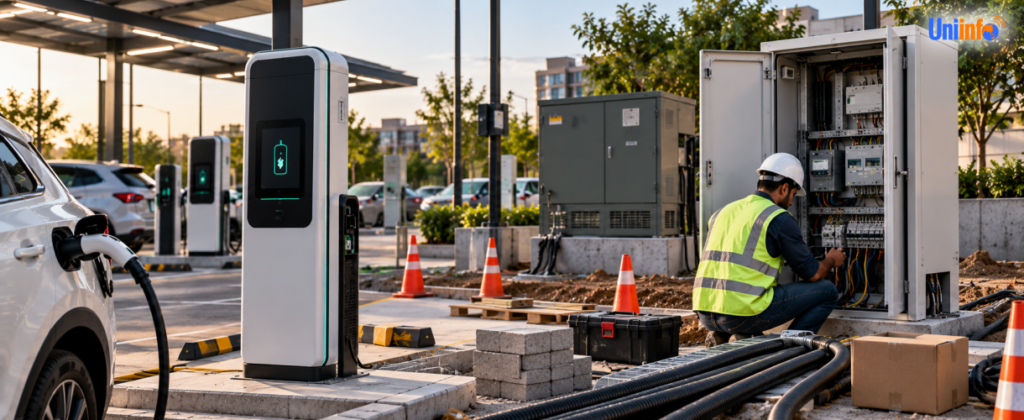
Setting up an EV charging station involves more than purchasing a charger. Electrical upgrades, cabling, civil work, software, safety systems and ongoing maintenance can all affect the total investment.
A charger quotation may look affordable at first, but the final project cost can change after a site inspection reveals limited electrical capacity, long cable routes or additional infrastructure requirements.
For businesses planning a charging facility at a hotel, shopping mall, office, fleet depot or public location, understanding these costs before procurement can help prevent budget overruns and installation delays.
The key distinction is simple: the price of an EV charger is not the same as the total cost of installing and operating an EV charging station.
India’s EV charging infrastructure framework covers equipment, electrical systems, safety provisions, communications and other installation requirements. The exact scope depends on the site, charger configuration and applicable regulations.
This article examines the main expenses to consider before approving an EV charging project.
Electrical Load Upgrades and Power Availability
The first step in planning an EV charging station is assessing the site’s available electrical capacity.
A commercial property may already have electricity for lighting, air conditioning, lifts, machinery and other equipment. However, an existing connection does not automatically mean the property has enough spare capacity to support additional EV chargers.
For example, installing a 60 kW DC charger requires a different power assessment from installing several lower-powered AC chargers. The assessment should account for the existing load, the proposed charging equipment and the possibility of multiple vehicles charging simultaneously.
Before selecting a charger, review the sanctioned electrical load, peak demand, available capacity, number of planned charging points and anticipated future demand.
If the existing supply cannot support the additional load, the project may require a load enhancement or other electrical upgrades. These requirements can affect both installation costs and the project timeline.
Uni-Info’s EV charging infrastructure solutions can be considered when planning site requirements, electrical infrastructure and future scalability.
Transformer, Electrical Panels and Distribution Equipment
The infrastructure connecting the electricity supply to the charging equipment can account for a significant part of the project budget.
Depending on the site’s existing electrical system, installation may require new or upgraded distribution panels, circuit protection, metering equipment, switchgear or transformer capacity.
However, a new transformer is not required for every EV charging station. The need depends on the available supply, proposed charging load and the condition of the existing infrastructure.
Consider two businesses installing the same 60 kW charger. One property may already have suitable electrical capacity and distribution equipment. The other may need substantial upgrades before installation can proceed.
This is why a charger-only quotation cannot provide a complete picture of the investment. Electrical requirements should be assessed before the final project budget is approved.
Cabling, Trenching and Cable Routing
The distance between the power source and the charging location can affect installation costs.
A charger positioned close to the electrical panel may require relatively little cabling. A charger located across a large car park may need longer cable runs, underground trenching, protective conduits and restoration of the affected surface.
The cable specification also depends on factors such as electrical load, cable length, installation method and applicable electrical requirements.
A site assessment should account for cable sizing, routing restrictions, trays or conduits, trenching, earthing and surface restoration.
For properties with multiple parking levels or outdoor charging bays, cable routing should be planned before the final charger positions are confirmed.
Practical consideration: Finalise the charging layout alongside the electrical design. Moving a charger after infrastructure work has started can lead to avoidable costs.
Civil Work and Site Preparation
EV charging equipment must be installed in a location that is suitable for its intended use. Depending on the property, site preparation can include foundations, mounting structures, parking-bay markings, bollards, signage, drainage considerations and surface restoration.
An office basement may need a different installation approach from a hotel car park, fleet depot or highway charging facility.
Outdoor installations may also require suitable weather protection and protection against accidental vehicle impact, depending on the equipment and site design.
Businesses should confirm which civil works are included in the installation quotation and which must be arranged separately.
A complete estimate should clearly identify the costs associated with preparing the charging area, routing cables and making the site ready for operation.
Earthing, Electrical Protection and Safety
Electrical safety requirements should be included in the initial project design rather than treated as additional work at the end of installation.
Depending on the system and applicable standards, an EV charging project may require appropriate earthing, circuit protection, isolation, surge protection and emergency provisions.
The equipment and installation should be assessed against the relevant technical requirements and the site’s operating conditions.
Businesses planning installations in India can consult the Bureau of Energy Efficiency’s EV charging resources and the applicable Ministry of Power guidelines.
The installation proposal should specify which protection and safety components are included, who is responsible for testing, and what documentation will be provided at commissioning.
Charging Management Software and Connectivity
Commercial EV charging stations may require software in addition to the physical charging equipment.
Depending on the business model, a charger management system (CMS) may support remote monitoring, user authentication, billing, tariff management, charging-session records, usage reports and remote diagnostics.
Network connectivity may also be necessary for monitoring and managing connected chargers.
Some manufacturers include software access or connectivity for a defined period, while other arrangements involve separate recurring charges. Businesses should confirm the terms before choosing a solution.
Questions to ask include whether the CMS is included in the quotation, whether annual subscription fees apply, how payments and tariffs are managed, and whether the system can support additional chargers later.
Uni-Info’s commercial EV charger solutions are relevant for businesses evaluating features such as monitoring, billing, authentication and load management.
Utility Connections, Metering and Commissioning
A delivered charger is not necessarily a commissioned charging station.
Depending on the project, additional work may involve electricity-connection approvals, utility coordination, metering arrangements, installation testing, documentation and commissioning.
The requirements can differ according to the location, existing electrical supply and type of charging facility.
Before agreeing to a delivery or launch date, establish which approvals and installation activities must be completed before the station can operate.
The Ministry of Power’s EV charging infrastructure guidelines provide a reference for planning charging infrastructure in India. The applicable requirements should be confirmed for the specific project.
Recurring Electricity and Operating Costs
The initial installation budget covers only part of the financial commitment. Once the charging station begins operating, the business must account for recurring expenses.
These may include electricity consumption, applicable demand charges, software subscriptions, connectivity, payment processing, maintenance and customer support.
The actual cost structure depends on the electricity tariff, operating hours, charging utilisation and business model.
For a public charging station, revenue potential depends partly on how frequently chargers are used and how much electricity is delivered to customers. A fleet depot may have a different utilisation pattern and cost structure.
Before investing, estimate both the initial capital expenditure (CAPEX) and the ongoing operating expenditure (OPEX).
A useful assessment considers the total installation cost, expected charging demand, electricity expenses, maintenance, downtime and anticipated revenue where relevant.
Maintenance, Repairs and Charger Downtime
Warranty coverage is important, but businesses should also assess what happens when a charger needs servicing.
Potential expenses include preventive maintenance, annual maintenance contracts, technician visits, replacement components, connector servicing and software support.
Downtime can create additional operational costs. A public station may lose charging sessions while equipment is unavailable, whereas a fleet operator may face disruption to vehicle schedules.
Before selecting a supplier, confirm the warranty terms, maintenance coverage, response times, availability of replacement parts and access to remote diagnostics.
The aim is to understand the support available throughout the equipment’s operating life, rather than comparing suppliers on purchase price alone.
Future Expansion and Additional Charging Points
A charging station that meets today’s requirements may need to accommodate more vehicles as demand grows.
If the initial electrical layout and cable routes are designed only for the first chargers, expansion may involve replacing panels, reopening trenches or upgrading distribution infrastructure.
Planning for future capacity does not necessarily mean purchasing additional chargers immediately. It means considering future charging bays, cable pathways, distribution capacity, load management and scalable software during the initial design.
For commercial properties and fleet operators, this approach can reduce the amount of rework required when additional charging points are introduced.
Uni-Info’s EV infrastructure services can be reviewed as part of planning a scalable charging installation.
EV Charging Station Cost Breakdown: What Should Your Budget Include?
The following table provides a budgeting framework. It does not represent fixed prices or indicate that every project requires every component.
| Cost category | What to assess |
| Charging equipment | Charger type, power rating and number of units |
| Electrical upgrades | Available load, distribution panels and transformer requirements where applicable |
| Cabling | Cable specifications, distance, conduits and trenching |
| Civil work | Foundations, mounting, parking preparation and surface restoration |
| Safety systems | Earthing, protection equipment and required safety provisions |
| Software and connectivity | CMS, billing, monitoring and recurring subscriptions |
| Utility and commissioning | Connection requirements, metering, testing and documentation |
| Maintenance | Warranty, servicing, replacement parts and support |
| Operating expenses | Electricity, demand charges and day-to-day operations |
| Future expansion | Reserved capacity, additional bays and scalable infrastructure |
Ask suppliers to separate equipment costs, installation charges, recurring fees and exclusions. This makes quotations easier to compare and helps identify expenses that may otherwise appear after work begins.
Why the Same EV Charger Can Have Different Installation Costs
Consider two hypothetical commercial properties purchasing the same 60 kW DC charger.
Site A already has suitable electrical capacity. The charging point is close to the power source, the parking area is prepared and only limited installation work is required.
Site B needs electrical upgrades, longer cable routes, trenching, new parking bays, connectivity and additional infrastructure.
Although both businesses purchase the same charger, their total installed costs can differ considerably.
The difference comes from site conditions and project requirements, not necessarily from the equipment itself.
Businesses can review Uni-Info’s EV charging projects to understand the range of deployment environments relevant to charging infrastructure.
Questions to Ask Before Accepting an EV Charger Quotation
Before approving a proposal, confirm the following points with the supplier:
- Is the quotation for the charger alone or a complete installed solution?
- Has the site’s electrical capacity been assessed?
- Are distribution panels, protection and earthing included?
- How much cabling and trenching will be required?
- Which civil works are included or excluded?
- Are software, CMS and connectivity charges covered?
- Will recurring subscription or maintenance fees apply?
- What warranty and after-sales support are provided?
- Can the infrastructure accommodate additional chargers later?
- Which approvals, tests and commissioning activities remain outstanding?
The answers help establish whether a quotation covers the full project or only selected components.
Plan Your EV Charging Project Before Buying Equipment
The total cost of setting up an EV charging station depends on more than the charger model or power rating. Electrical capacity, cable distance, site preparation, software, safety systems and ongoing operating costs all influence the investment.
The more effective sequence is to assess the site, establish its electrical requirements, select suitable chargers, design the infrastructure and prepare a complete cost estimate before procurement.
This approach gives businesses a clearer view of the work involved and helps reduce unexpected expenses during installation.
Get Your EV Charging Project Assessed
Planning EV charging for a hotel, shopping mall, office, fleet depot, highway location or public charging business?
Uni-Info can help you evaluate your EV charging infrastructure requirements and plan the next steps for your project.
Request an EV Charging Project Assessment
Assess your site’s requirements before finalising your EV charger investment.