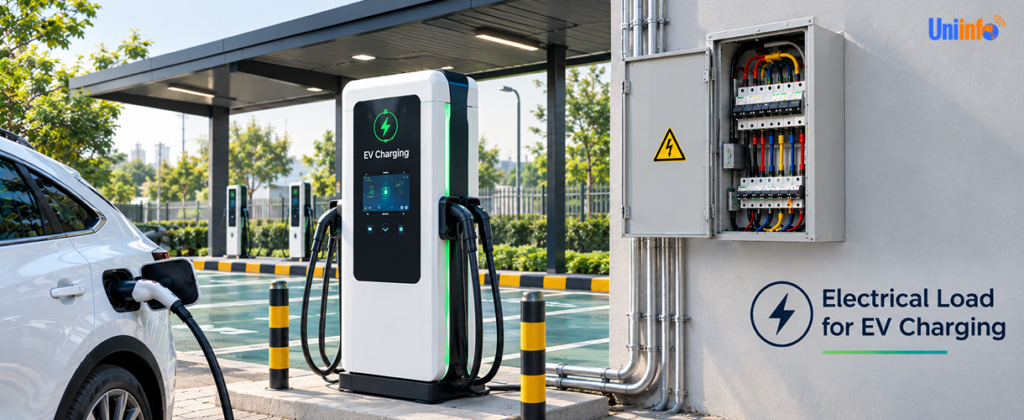
If you’re planning to install EV chargers at a hotel, office, apartment complex, or fleet depot, one question can shape your budget before you buy any equipment: Can your existing power connection support the chargers you want to install?
The answer depends on three things: how much power each charger draws, how many chargers will run at the same time, and how much electricity your property already uses during those hours. Two 60 kW DC chargers, for example, can deliver a combined 120 kW to vehicles at full output. Their combined electrical input will be higher, and your site must also support any building equipment running at the same time.
How to Calculate the Electrical Load for an EV Charging Station
Start with the charger’s technical datasheet. The output rating tells you how much power the charger can deliver to a vehicle. The input rating tells you how much it draws from the electrical supply. For a DC charger, the difference includes power conversion losses and power used by the charger itself.
Next, estimate how much electricity your property uses during the hours when charging demand is likely to peak. For a commercial building, that could include air conditioning, lifts, lighting, and other equipment.
Estimated site demand = existing property demand during charging hours + combined input demand of chargers operating at the same time.
Suppose your property draws 80 kW during the expected charging peak. If one charger has a rated input of 65 kW, the estimated combined demand is 145 kW. If two identical chargers run at full power alongside that same building load, the estimate rises to 210 kW.
If your electricity bill lists sanctioned load or contract demand in kVA, ask your electrical team to compare the figures on a consistent basis. Converting between kW and kVA requires the relevant power factor.
How Much Power Do Different Charging Setups Need?
| Property type | Example charger setup | Combined output at full simultaneous use |
| Apartment or workplace | Four 7.4 kW AC chargers | 29.6 kW |
| Hotel or commercial property | Two 22 kW AC chargers | 44 kW |
| Public fast-charging station | Two 60 kW DC chargers | 120 kW |
| Fleet depot | Three 60 kW DC chargers | 180 kW |
These examples show combined charger output. For supply planning, use the selected equipment’s input ratings and consider how vehicles will use the site.
At an office, employees may leave their vehicles plugged in for several hours, giving you room to share power between bays. A public fast-charging station may need to serve several drivers at once to keep queues manageable. At a fleet depot, the deciding factor may be whether every vehicle can get enough charge before its next scheduled departure.
Can You Use Your Existing Electricity Connection?
Pull out a recent electricity bill and look for the sanctioned load or contract demand. Check the recorded maximum demand if it’s available. This gives you an initial view of how much capacity may be available for charging, especially if you can see when the property’s demand peaks.
The electrical equipment matters too. Your connection may have spare capacity while the panel serving the parking area, the cable route, or the protection equipment needs work. A site assessment can help you decide which of these options fits:
- Use the existing supply if it can handle the combined demand and the electrical equipment can support the installation.
- Manage charging demand by sharing power across chargers or scheduling sessions around the property’s busiest hours.
- Plan a load enhancement or electrical upgrade if the site needs more capacity than the existing setup can provide.
If your project requires a new connection or an increase in sanctioned load, check the process with your local electricity distribution company before committing to an installation timeline. static.investindia.gov.in
Already have a site in mind? Share your location, property type, and planned number of charging bays with Uniinfo. Request a site survey
Can Load Management Reduce the Need for an Upgrade?
Load management can cap the total power your chargers draw. At a workplace, for example, the system can reduce charging power when the building’s electricity demand rises and make more power available when demand falls. A fleet operator can schedule charging around departure times so the vehicles needed first get priority.
The trade-off is charging time. If your vehicles stay parked for several hours, sharing power may still meet their needs. If several vehicles need a fast charge within the same short window, the site may need more electrical capacity. When planning a phased rollout, tell your installer how many bays you expect to add later. That can inform panel sizing and cable routing from the start.
What Does Uniinfo Check During a Site Survey?
Uniinfo reviews your incoming supply, existing demand, proposed charger locations, and cable routes. We also ask how many vehicles you expect to charge at once and how long they typically stay. That helps us recommend whether to use your existing supply, manage demand across chargers, or plan an upgrade. Explore Uniinfo’s EV charging infrastructure services
Frequently Asked Questions
Does a 60 kW charger need exactly 60 kW of electrical input?
A 60 kW DC charger is rated to deliver up to 60 kW to the vehicle. Check the manufacturer’s input rating to estimate how much it draws from your site.
Do I need a separate transformer for a DC fast charger?
It depends on the charger’s input demand, the capacity of your existing supply and transformer, and the local utility’s connection requirements. A site assessment can identify what your project needs.
Can I request a site survey before choosing a charger?
Yes. Share your site location, property type, and the number of vehicles or bays you want to support. If you have a recent electricity bill, it can help make the first discussion more specific.
Find out how much power your site needs before ordering chargers. Fill out the enquiry form with your city or PIN code and planned charging setup. Uniinfo can help you assess the available supply and identify any upgrades your installation may require. Request an EV charging site survey